Goldenrod & Black-Eyed Susans: Growing Native Flowers That Pollinators Love

Beautify your landscape & support native pollinators by growing goldenrod & Black-Eyed Susans. Here are some common myths & tips for growing these native flowers…
Article-At-A-Glance:
- Black-eyed Susans (Rudbeckia) and goldenrod (Solidago) are two of the most powerful native plants you can grow to support local pollinator populations.
- The dark center “eye” of a black-eyed Susan is not one flower — it is actually hundreds of tiny individual blooms, each holding nectar for bees, wasps, butterflies, and moths.
- Goldenrod is wrongly blamed for hay fever season, but its pollen is too heavy to be airborne — ragweed is the real culprit blooming at the same time.
- Penn State researchers found that Rudbeckia cultivars attract a wide variety of bee species, making them one of the most ecologically valuable ornamental plants available.
- Planting native flowers in drifts — groupings of the same species — attracts significantly more pollinators than single isolated plants.
Two Native Flowers That Pollinators Cannot Resist
Most gardeners want to help pollinators, but not everyone knows which plants actually deliver results. Goldenrod and black-eyed Susans are two North American native flowers that consistently outperform exotic ornamentals when it comes to feeding and supporting local bee, butterfly, and moth populations. They are tough, beautiful, and once established, surprisingly low maintenance!

Image from www.nurturenativenature.com.
These plants do more than look good. They form the backbone of a functioning pollinator garden by providing nectar, pollen, and habitat across multiple seasons. Whether you are starting a new garden bed or filling gaps in an existing border, these two natives belong in the plan.
What Makes Black-Eyed Susans So Valuable to Pollinators
Black-eyed Susans belong to the genus Rudbeckia, and two species in particular — Rudbeckia fulgida and Rudbeckia hirta — are the stars of the native garden. Their bright yellow petals act as a visual landing pad, drawing in pollinators from a distance. Once an insect lands, the real reward begins at the center of the flower.
The Center Eye Is Actually Hundreds of Tiny Flowers
That dark brown dome at the center of every black-eyed Susan is not just decorative. It is made up of hundreds of individual tiny florets, each one holding a small reservoir of nectar. Bees, small wasps, flies, butterflies, and moths all feed from these florets. This structure makes a single black-eyed Susan bloom the equivalent of an entire buffet for visiting insects!
18 Species Use Rudbeckia as a Host Plant in Pennsylvania
Beyond nectar, Rudbeckia plays a deeper ecological role. At least 18 insect species use black-eyed Susans as a host plant in Pennsylvania alone, meaning they rely on the plant to complete part of their life cycle. A Penn State study by researchers Emily Erickson, Harland Patch, and Christina Grozinger confirmed that Rudbeckia cultivars attract a wide variety of bee species, making them one of the most ecologically productive ornamental plants available to home gardeners. For those interested in sustainable gardening or supporting native pollinators, consider exploring growing wild bergamot, another native plant with environmental benefits.
Birds Feed on the Seed Heads Through Winter
The benefits of black-eyed Susans do not stop when the blooms fade. If you leave the spent flower heads standing through fall and winter, several bird species will return repeatedly to feed on the nutritious seeds packed inside. This is one of the best arguments for delaying your garden clean-up until spring — the seed heads become a winter food source that supports wildlife long after the growing season ends.

Image from en.wikipedia.org.
Rudbeckia Varieties Worth Growing in Your Garden
Not all Rudbeckia cultivars are created equal, and knowing which ones to choose will save you time, money, and disappointment at the nursery. The species differ in height, bloom duration, disease resistance, and the specific pollinators they attract most reliably.
Rudbeckia hirta vs. Rudbeckia fulgida: Which to Choose
Rudbeckia hirta tends to be shorter-lived, often behaving as a biennial or short-lived perennial, but it self-seeds readily and produces an extraordinary range of flower colors beyond the classic yellow. Cultivars like ‘Autumn Colors’ and ‘Cherry Brandy’ bring warm burgundy and orange tones into the mix. Rudbeckia fulgida, on the other hand, is a reliable long-lived perennial. Its cultivar ‘Goldsturm’ is one of the most widely planted, growing 24 to 36 inches tall with classic yellow blooms, though it is prone to angular leaf spot disease. The cultivar ‘Forever Gold’ offers a more compact form at 18 to 24 inches with excellent disease resistance.
How to Use Height and Bloom Time to Plan Your Border
A well-planned border uses height and bloom time strategically. Place taller varieties like ‘Goldsturm’ at the back of a border and compact varieties like ‘Forever Gold’ toward the front. Research from Penn State indicates that planting Rudbeckia in drifts — clusters of the same variety — attracts significantly more pollinators than single isolated plants. Aim for groupings of at least three to five plants of the same cultivar for maximum impact.
How Goldenrod Supports Pollinators From Summer Into Fall
Goldenrod (Solidago) is one of the most important native plants in North America for late-season pollinators, yet it remains one of the most misunderstood and underused garden plants. It blooms from late summer into fall, filling the critical window when most other flowers have finished and pollinators are still actively building their winter reserves. More than 100 bee species depend on goldenrod as a primary pollen and nectar source. For more on enhancing your garden sustainably, consider enhancing fire resistance with native plants.

Image from yardandgarden.extension.iastate.edu.
Stiff Goldenrod vs. Showy Goldenrod: Key Differences
Two goldenrod species stand out for home gardens. Stiff goldenrod (Solidago rigida) grows 2 to 4 feet tall and produces flat-topped clusters of bright yellow flowers that are particularly attractive to monarch butterflies and bumblebees. It thrives in dry to medium soils and full sun. Showy goldenrod (Solidago speciosa) reaches 2 to 3 feet with upright, wand-like plumes and is considered one of the most ornamentally attractive species in the genus — making it easier to incorporate into formal garden designs without it looking wild or weedy.
Why Goldenrod Is Unfairly Blamed for Hay Fever
Goldenrod has been blamed for hay fever for decades, but the science simply does not support it. Goldenrod pollen is heavy and sticky — it is designed to be carried by insects, not the wind. It cannot travel through the air in quantities large enough to trigger allergic reactions in most people.
The real culprit is ragweed (Ambrosia artemisiifolia), which blooms at exactly the same time as goldenrod and produces enormous quantities of lightweight, airborne pollen. Because ragweed is less visually striking, goldenrod gets the blame by association. Once you understand this distinction, there is no good reason to keep goldenrod out of your yard!
- Goldenrod pollen is heavy and sticky — carried by insects, not wind
- Ragweed blooms at the same time and produces lightweight airborne pollen that triggers hay fever
- Goldenrod supports over 100 bee species as a late-season nectar and pollen source
- Both Solidago rigida and Solidago speciosa are well-behaved enough for formal garden borders
- Goldenrod is an important monarch butterfly nectaring plant during fall migration
Replacing the ragweed-goldenrod myth with the facts opens up one of the most rewarding plant choices you can make for a fall pollinator garden. Few plants deliver as much ecological value with as little care once they are established.
Native Plants That Pair Well With Goldenrod and Black-Eyed Susans
The secret to a thriving pollinator garden is layering bloom times so that something is always flowering from early spring through late fall. Goldenrod and black-eyed Susans cover the summer-to-fall window beautifully, but pairing them with complementary native plants extends the season and creates a more diverse habitat that supports a wider range of species.
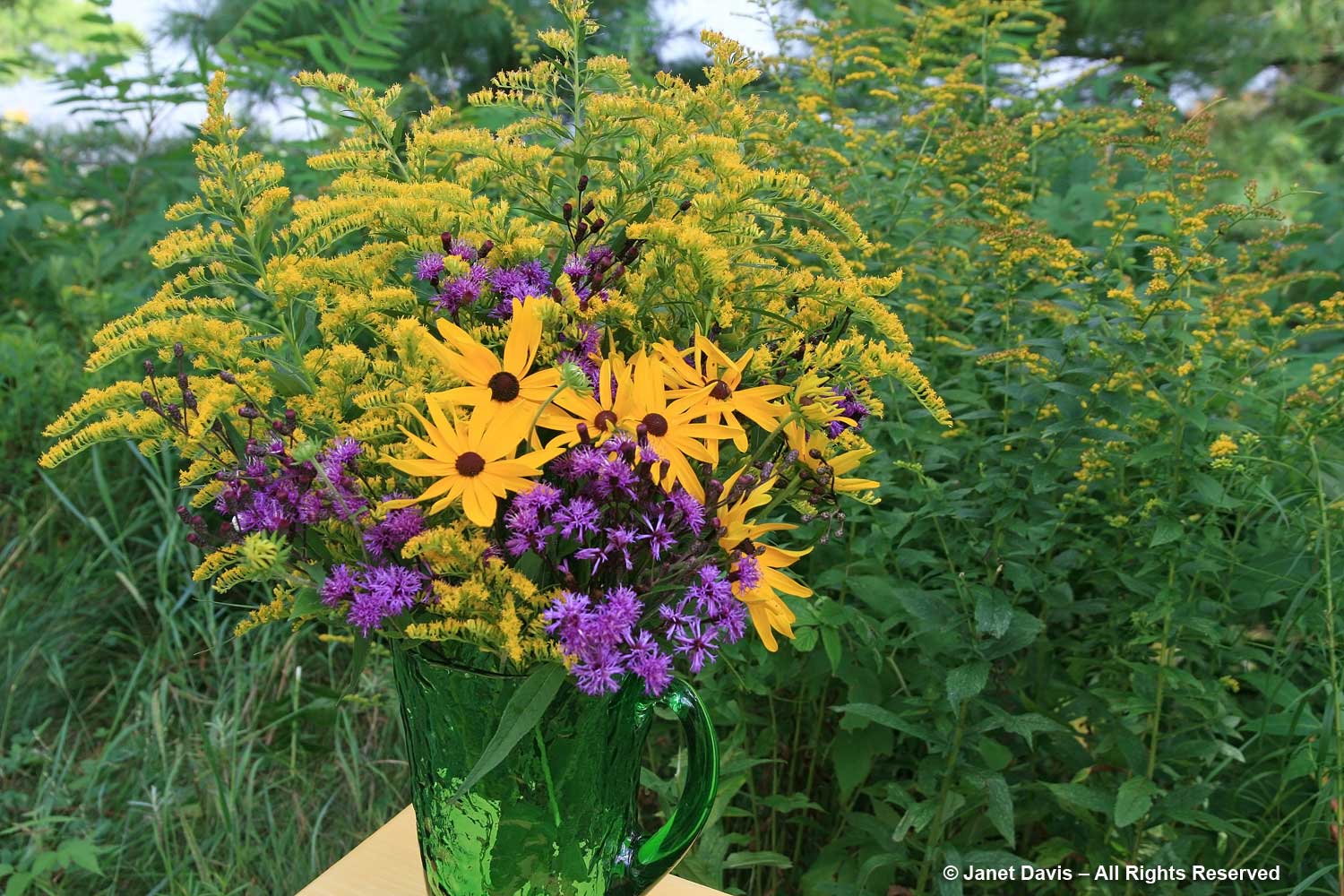
Image from www.thepaintboxgarden.com.
Spring Bloomers to Bridge the Gap Before Summer
Wild bergamot (Monarda fistulosa) is one of the best spring-to-summer bridge plants, producing lavender-pink flowers that attract bumblebees, hummingbirds, and sphinx moths. Butterfly milkweed (Asclepias tuberosa) blooms in vivid orange from late spring into summer and is the primary larval host plant for monarch butterflies. Dense blazing star (Liatris spicata) adds vertical interest with its purple flower spikes and draws in an impressive range of bees and butterflies before the goldenrod season kicks in.
Fall Bloomers to Extend the Pollinator Season
Joe-pye weed (Eutrochium fistulosum) is a tall, architectural plant that bridges late summer and fall with its dusty mauve flower clusters. It pairs naturally with goldenrod in height and bloom time and is particularly attractive to tiger swallowtail butterflies. Native asters, especially New England aster (Symphyotrichum novae-angliae), extend the season into October and are critical late-season food sources for migrating monarchs and native bees preparing for winter.
How to Grow Black-Eyed Susans Successfully
Quick-Reference Growing Guide: Black-Eyed Susans (Rudbeckia)
Factor Requirement Sun Full sun (6+ hours daily); tolerates light shade Soil Average to poor; well-drained; tolerates clay Water Drought-tolerant once established; moderate during first season Planting Time Late spring or fall (6 weeks before first frost) Height Range 18 to 36 inches depending on cultivar Bloom Period July through October Spacing 18 to 24 inches apart
Black-eyed Susans are genuinely forgiving plants, but a few simple steps at planting time will set them up for years of reliable performance. Starting with transplants from a reputable nursery is the most practical approach for most gardeners. When purchasing, always confirm the plant is labeled Rudbeckia — the name black-eyed Susan is also used for Thunbergia alata, a completely different plant that is not cold-hardy in most of North America.
Spring plant sales are excellent sources for Rudbeckia cultivars, often at lower prices than garden centers. If you prefer to start from seed, direct sow in fall for spring germination, or start indoors 8 to 10 weeks before the last frost date. Seeds need light to germinate — press them onto the soil surface rather than covering them. For more information on native plant picks, visit this Oregon State University guide.

Image from www.housedigest.com.
Soil, Sun, and Water Requirements
One of the most common mistakes gardeners make is over-amending the soil before planting black-eyed Susans. These plants evolved in lean, well-drained conditions and actually perform better in average to poor soil than in rich, heavily fertilized beds. Overly fertile soil produces lush foliage at the expense of flowers and can make plants floppy and prone to disease.
Full sun — at least six hours of direct sunlight daily — is non-negotiable for best flowering. Rudbeckia will tolerate light shade, but bloom production drops noticeably. Once established in their second season, black-eyed Susans are heat and drought-tolerant, blooming reliably from July into October with minimal supplemental watering.
When to Deadhead and When to Leave the Flower Heads Alone
Deadheading spent blooms through mid-summer encourages more flowers and keeps plants looking tidy. However, as the season moves into September and October, stop deadheading and allow seed heads to mature fully. These seed heads are a direct food source for finches and other seed-eating birds through winter, and they also allow the plant to self-seed naturally — gradually expanding your planting for free.
Native Flower Recommendations by U.S. Region
Native plants perform best when matched to their region of origin. While Rudbeckia and Solidago species are found across much of North America, choosing locally native species and cultivars gives you plants that are already adapted to your specific soil types, rainfall patterns, and seasonal temperatures. The table below highlights strong native flower choices organized by U.S. region to help you build a regionally appropriate pollinator garden.
Southeast Region: Alabama, Florida, Georgia, and More
Gardeners in the Southeast work with heat, humidity, and a longer growing season than most of the country. Rudbeckia hirta is particularly well-suited here, thriving in the region’s warm summers and tolerating the occasional drought that comes with Southern summers. Native goldenrod species like Chapman’s goldenrod (Solidago odora) and seaside goldenrod (Solidago sempervirens) are excellent regional choices, with seaside goldenrod handling sandy coastal soils with ease. Pair these with butterfly milkweed (Asclepias tuberosa) and wild bergamot for a complete spring-to-fall pollinator sequence.

Image from www.prairiemoon.com.
Northeast Region: Connecticut, New York, Pennsylvania, and More
The Northeast is where much of the foundational research on native pollinator plants has been conducted, including the Penn State studies on Rudbeckia cultivars. Rudbeckia fulgida ‘Goldsturm’ and ‘Forever Gold’ both perform reliably across this region. New England aster (Symphyotrichum novae-angliae) is a must-have companion for fall, extending the pollinator season well into October when most other plants have finished. Stiff goldenrod (Solidago rigida) thrives in the Northeast’s full sun borders and is one of the top monarch nectaring plants during the fall migration corridor along the Atlantic coast.
Native Flower Recommendations by U.S. Region
Region Recommended Native Flowers Key Pollinators Supported Southeast (AL, FL, GA) Rudbeckia hirta, Seaside Goldenrod, Butterfly Milkweed Monarchs, Gulf Fritillaries, Native Bees Northeast (CT, NY, PA) Rudbeckia fulgida ‘Goldsturm’, Stiff Goldenrod, New England Aster Bumblebees, Monarchs, Tiger Swallowtails Midwest (IL, OH, MN) Orange Coneflower, Showy Goldenrod, Dense Blazing Star Native Bees, Painted Ladies, Skippers Great Plains (KS, NE, OK) Black-Eyed Susan, Stiff Goldenrod, Wild Bergamot Bumblebees, Monarchs, Sweat Bees Pacific Northwest (OR, WA) Rudbeckia hirta, Canada Goldenrod, Joe-Pye Weed Mason Bees, Swallowtails, Hoverflies
Use this table as a starting framework rather than a rigid prescription. Native plant availability varies by state and even by county, and locally sourced plants — those grown from seed collected in your specific region — will almost always outperform cultivars grown from seed collected elsewhere. Ask your local native plant nursery whether their stock is locally sourced whenever possible.
Regional native plant societies are an outstanding resource for finding species that are genuinely native to your county or zip code rather than just your broader region. Organizations like the New England Wild Flower Society, the Georgia Native Plant Society, and the Illinois Native Plant Society often run annual plant sales with locally provenance-verified stock that can be difficult to find anywhere else.
One final note on regional planting: the Midwest and Great Plains regions are home to some of the most diverse native bee communities in North America. Gardeners in these areas have an outsized opportunity to support species like mining bees, sweat bees, and leafcutter bees that depend heavily on Rudbeckia and Solidago species as primary food sources throughout the growing season.

Image from soagithaca.org.
Start Small, Then Let Your Pollinator Garden Grow
You do not need to overhaul your entire yard to make a real difference for pollinators. Start with a single sunny bed of five to seven plants — a drift of Rudbeckia fulgida ‘Forever Gold’ paired with two or three plants of showy goldenrod (Solidago speciosa) — and you will see results within the first season. Once you watch the variety of bees, butterflies, and other insects working those flowers on a warm August afternoon, expanding the planting tends to happen naturally!
The goal is continuity — something always blooming from spring through hard frost. Add one or two new species each year, prioritizing plants that fill gaps in your bloom calendar. Within three to four seasons, you will have a self-sustaining, layered garden that requires less intervention every year as the plants establish deep root systems and begin to self-seed. Native gardens reward patience, and the ecological returns compound over time.
Frequently Asked Questions
These are the questions that come up most often when gardeners start exploring native flowers for pollinators. The answers below cut through the common myths and give you practical, actionable information.
Is Goldenrod Safe to Plant Near Other Garden Flowers?
Yes, goldenrod is safe to plant near other garden flowers and does not harm neighboring plants through chemical interference. Some gardeners worry about goldenrod spreading aggressively, and while certain species like Canada goldenrod (Solidago canadensis) can spread vigorously by rhizome in ideal conditions, well-behaved cultivars like Solidago speciosa and Solidago rigida are far less aggressive and suitable for mixed borders without regular division.
If you are concerned about spread, choose clump-forming goldenrod species rather than rhizomatous ones, and divide established clumps every three to four years to keep them contained. This is standard maintenance for most perennials and is not uniquely burdensome with goldenrod. The ecological benefits of including goldenrod in your garden far outweigh the minor management it occasionally requires.
How Long Do Black-Eyed Susans Bloom Each Season?
Black-eyed Susans are among the longest-blooming native perennials available. Rudbeckia fulgida and its cultivars typically bloom from July through October — a full three to four months of continuous flower production. Deadheading spent blooms in the early part of the season encourages additional flower production, while stopping deadheading in September allows the plant to set seed for birds and for natural self-seeding into the surrounding soil.
Do Black-Eyed Susans Come Back Every Year?
Rudbeckia fulgida is a true perennial and returns reliably each year in USDA hardiness zones 3 through 9, with root systems that survive well below freezing. Rudbeckia hirta is shorter-lived — often behaving as a biennial or short-lived perennial — but it self-seeds so readily that established plantings tend to perpetuate themselves without any intervention from the gardener.
Rudbeckia Lifespan at a Glance
Species Lifespan Self-Seeds? Hardiness Zones Rudbeckia fulgida True perennial Moderately Zones 3–9 Rudbeckia hirta Biennial / short-lived perennial Prolifically Zones 3–7
The self-seeding habit of Rudbeckia hirta is actually one of its most useful qualities. An initial planting of five plants can quietly expand into a full naturalized drift over two to three seasons with no additional effort or expense on your part. The key is to leave some seed heads standing through winter and to avoid heavy mulching directly around the base of the plants, which can prevent seeds from making contact with the soil.
If you want a more controlled planting with predictable height and form year after year, Rudbeckia fulgida ‘Forever Gold’ or ‘Goldsturm’ are the more dependable choices. These cultivars maintain consistent size and flower production without the variability that comes with self-seeding populations.
Either way, once established, you will rarely need to replant. The combination of true perennial root systems in Rudbeckia fulgida and prolific self-seeding in Rudbeckia hirta means that a well-sited planting of black-eyed Susans tends to be a one-time investment that pays dividends for many years.
What Pollinators Are Most Attracted to Goldenrod?
Goldenrod is one of the most ecologically productive flowering plants in North America for late-season pollinators. More than 100 native bee species use goldenrod as a primary pollen and nectar source, including bumblebees, sweat bees, mining bees, and specialist Colletes bees that are completely dependent on goldenrod pollen to provision their nests. Monarch butterflies rely heavily on goldenrod nectar during their fall migration to build the fat reserves they need to survive the journey to Mexico.
Beyond bees and butterflies, goldenrod attracts a remarkable diversity of other insects including hoverflies, soldier beetles, and various wasp species, which in turn attract insect-eating birds to the garden. The ecological cascade that begins with a few goldenrod plants in bloom is genuinely impressive — it is one of the best single investments you can make in your garden’s biodiversity!
Where Can I Buy Native Rudbeckia and Goldenrod Plants?
Most well-stocked garden centers and nurseries carry at least one or two Rudbeckia cultivars, particularly Rudbeckia fulgida ‘Goldsturm’, which is widely available across the country. When purchasing, always confirm the botanical name on the label — the common name black-eyed Susan is shared with Thunbergia alata, which is a tropical vine with no cold hardiness in most of North America.
For goldenrod, specialty native plant nurseries are your best bet for finding species beyond Canada goldenrod. Look specifically for Solidago rigida and Solidago speciosa, which are the most garden-friendly species and least likely to spread beyond their designated space. Regional native plant society sales, held in spring in most states, frequently offer locally provenance-verified goldenrod at prices well below commercial nurseries.
Online native plant nurseries have expanded significantly in recent years and now ship bare-root or potted plants across most of the contiguous United States. Reputable sources include Prairie Nursery in Wisconsin, American Meadows, and Missouri Wildflowers Nursery, all of which carry a strong selection of both Rudbeckia and Solidago species suited to multiple regions. Always cross-reference with your local extension service to confirm a species is native to your specific area before purchasing.
Featured Image from www.gardenia.net.

Related Posts
-
 Enhancing Fire Resistance in Your Garden with Native Plants
-
 Backyard Pollinator Garden Guide: Native Insect-Friendly Planting Tips & Techniques
-
 How to Support Native Pollinators On Your Homestead
-
 Building a Rain Garden Using Swamp Milkweed: A Step-by-Step Guide
-
 Planting Native Switchgrass for Erosion Control
-
 Ethical Seed Collection: Sustainable Guidelines for Harvesting Wildflower Seeds
